
Getting hold of the keys to your first rental property is hard enough, especially when you consider the effort required to raise the finance and then complete any renovations or necessary improvements. But then comes the next tricky bit, which some new landlords renting out a property might take for granted – finding a tenant willing to pay your rental valuation.
Find out how much rent you should charge for your property here: How much rent should you charge?
If there’s one sound bit advice we can pass on, it’s that when carrying out a rental valuation, ensure you have put yourself in the mind of a potential tenant.
Now, this doesn’t just mean showing off your property size, views, garden, freshly painted magnolia walls and location. Instead, think about how your prospective tenant, the one who is going to pay off your buy to let mortgage, will find your property in the first place.
There’s a lot of competition for good tenants, and you need to make sure they spot your advert. Many of these will join us online to scan for their dream rental properties.
And this is where the neat trick comes in.
What determines your property’s rental value?
A rental valuation is an estimate of the monthly rent your property can realistically achieve in today’s market. Several things feed into it:
- Location – the biggest factor: the town, the specific street, school catchments, transport links and local demand.
- Size and type – bedrooms and bathrooms, floor space, and whether it’s a flat, terrace, semi or detached home.
- Condition and finish – a clean, modern, well-kept property commands more than a tired one.
- Furnished or unfurnished – furnished lets can attract a small premium in some markets.
- Outdoor space and parking – a garden, off-street parking or a garage all add value.
- Energy efficiency – with bills front of mind, a better EPC rating is increasingly a selling point (and a minimum EPC C is due in England and Wales by 2030).
How to value your property, step by step
- Check the local market. Search Rightmove and Zoopla for similar nearby properties – same bedroom count, similar condition – and look at what is actually letting. “Let agreed” listings show the real market rate, not optimistic asking rents.
- Use an instant valuation. A free online tool gives an immediate, data-driven figure for your postcode in seconds – a solid starting point.
- Adjust for your specifics. Add or subtract for condition, parking, garden, furnishings and energy efficiency versus the comparables.
- Mind the search brackets (below) – where your figure sits against the portal filters matters as much as the figure itself.
Consider price brackets when carrying out a rental valuation online.
If you do search online, the first thing you’ll do is type in your preferred location – let’s say Ipswich – and then you’ll almost certainly define the minimum and maximum rent you’re willing to pay. In Ipswich, the great majority of people looking to rent a terraced house would probably put £500 a month minimum, and £700 a month maximum.
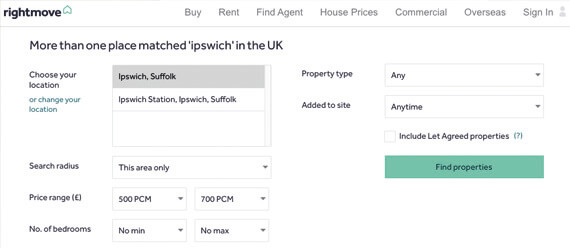
So, your starter for 10 is this: What’s the worst rental price you can settle on for your terraced house in Ipswich?
If you said £705, you win a sticker. Why? Because for the sake of trying to make an extra fiver a month, you have now eliminated your property from the search results that will be seen by most of your target audience!
Not only that, but those typing £700 minimum a month, and £1,000 maximum are going to be looking for something a little more exotic than your humble terrace, which has somehow snuck into their search results, and so they’ll ignore it, too.
Find out how much rent you should charge for your property here: How much rent should you charge?
£5 makes a big difference on your rental valuation.
It doesn’t take long to work out what a false economy it is to try to make that extra monthly £5.
Let’s say that because not as many people as you had hoped are seeing your property while searching online, that it stays empty for one month longer than planned.
That has now left you £705 out of pocket.
A quick computation on the back of your rental particulars will tell you that if you charged £700, it would take 141 months of losing that £5 a month to reach the same £705 figure.
That’s nearly 12 years!
And by that time, you’ve probably paid off your mortgage and are well on your way to becoming private landlord of the year.
How often can you increase the rent?
Pricing is not only a one-off decision, and the rules changed in 2026. In England, under the Renters’ Rights Act 2025 (from 1 May 2026), rent can be increased once every 12 months via a Section 13 notice with at least two months’ written notice. A tenant can challenge it at the First-tier Tribunal, and the Tribunal cannot set the rent higher than the figure you proposed. The increase must reflect the local market rate – which is exactly why an accurate, evidence-based valuation matters.
Wales and Scotland differ: Wales (Renting Homes (Wales) Act) also limits increases to once a year on two months’ notice; Scotland (the Private Residential Tenancy) has its own once-a-year process and rent-adjudication rules. Check the rules for the nation your property is in.
Common rental-valuation mistakes to avoid
- Over-pricing. A property that sits empty even a month usually wipes out the extra rent you were chasing (see the maths above).
- Pricing just above a search bracket – the most common avoidable error.
- Ignoring “let agreed” comparables and pricing off asking rents that never actually let.
- Forgetting your costs – agent fees, maintenance and void periods all affect your real return.
- Set and forget – review against the market at each renewal, within the once-a-year rules above.
Rental valuation FAQs
How much rent should I charge?
As much as the market will bear without leaving the property empty – usually in line with comparable “let agreed” properties nearby, adjusted for your property’s condition and features. An instant valuation gives an accurate starting figure for your postcode.
How is rental value calculated?
Mainly from local comparables for similar properties, then adjusted for size, condition, furnishings, parking, outdoor space and energy efficiency.
How often can I increase the rent?
In England, once every 12 months with two months’ notice under the Renters’ Rights Act 2025 (Wales and Scotland have their own once-a-year rules).
What’s your property worth in today’s market?
Get a free, no-obligation instant rental valuation for your postcode in seconds – then let our team help you get the best price. Thinking of letting? Compare our fixed-price letting plans.
Value my property →Get a professional rental valuation and best price guide from the experts!
Okay, so that’s a bit of fun to highlight a very serious point.
Carrying out a rental valuation to determine the price for your property needs to account for more than just the obvious decor, condition and location.
Of course, you need to know the ballpark figure that similar property lettings make, just make sure you take into account things like price brackets.
A quick play for yourself online will help you identify the distinct price brackets you need to be working within.
Look where the majority of properties like your own are sitting, and you’ll be able to make a good judgment call that balances the need to keep your property occupied (and the rent coming in) and making a few extra quid a month.
If you want to get the most rental income from your property and understand how you can improve your rental return, simply enter a few details about your property to generate an instant rental value and a member of our landlord team will be happy to help.