In short: set your rent using real local letting data rather than guesswork, and pitch slightly below the top of the market to let faster and attract reliable, long-term tenants. Remember that in England the Renters’ Rights Act 2025 bans rental bidding and limits increases to once a year.
I have often been asked the question of when should a landlord start marketing a property and at what price? In my experience, the two go very much hand in hand – the question really is “When will the property be vacant?” The answer to this question will determine your marketing strategy…
When Should I Start to Market My Property to Rent?
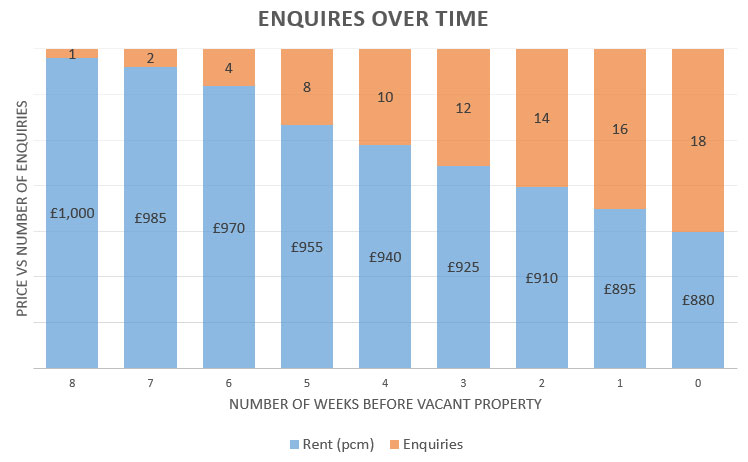
Consider the enquiries chart at the top of this article. Here we have an 8 week countdown before a property becomes vacant. Why 8 weeks? Firstly, you, as the landlord will need a valid reason (a “ground for possession”) and must serve a Section 8 notice giving the required notice period for that ground. Since 1 May 2026, Section 21 “no-fault” evictions have been abolished in England and tenancies are periodic rather than fixed-term, so you can no longer simply serve two months’ notice to end an Assured Shorthold Tenancy. During the notice period, you are able to remarket the property.
The first 4 weeks are crucial and this is often where we see landlords make the mistake of sitting tight and holding out for as much rent as possible. It is often forgotten that the majority of tenants looking to move will also either be on notice to vacate their current property or they have to give once months’ notice to their current landlord.
Ideally, you would want to have secured a new tenant by week 4 so that during the last month of your tenancy i.e. week 5 – 8, you know that you have a new tenant lined up and therefore avoid any void periods. If you only manage to secure a tenant in the last 4 weeks of marketing, chances are very high that the tenant won’t be able to move for at least another 4 weeks – leaving you with a mortgage to pay and loss of rent.
What Rent Amount Should I Go For?
There are many resources on the internet when you can start to get a picture of what the rental market looks like in your area. As a company, we market our properties on the likes of Rightmove, Zoopla, Prime location etc. and these websites combined hold a wealth of information to guide you when it comes to determining your price.
Put yourself in your next tenants shoes… do a search on one of the aforementioned websites and see what other 2 / 3 / 4 bedroomed properties are available in a ¼ mile radius and then widen the search to get a bigger picture of what’s available. You are looking for ‘comparables’ to your property i.e. same kind of décor, style of property, location to services etc.
Once you have identified a few, take a look at how long they have been on the market for. This is a great indication as to whether either there is something fundamentally wrong with the property or it has been priced too high.
Make sure you also search the properties that are marked as “Let Agreed” as these will be the strongest indicators of price.
And finally, again, considering the graph above. As you can see, although a crude example, this is generally the story when we market a property on behalf of a landlord. If the average price band in an area is say £900, however, we start at £1000, the number of enquiries are relatively low. However, as you start to reduce the rental amount, typically, the number of enquiries increases.
The best advice we could offer at this stage is firstly; market the property just under market value to encourage high levels of enquiries or secondly, if you do start at a higher price point, to reduce the rent by between £15 – £25 every week the property is marketed online.
I have a landlord who recently advertised a 1 bedroom flat in London for £75 less that the market average – he received 16 enquiries within 24 hours. Now, he arranges a block viewing and has the pick of the crop. Not only will he find a great tenant, the tenant will be more than likely to remain in the property long term as they know they have a good deal!
Rightmove provide LettingaProperty.com statistics on the activity of your advert once it has been running for 7 days.
These are indicative statistics of how well, or not, your property is performing in the market at that moment given the supply and demand in your area.
Ask your landlord team for a copy of a Property Report and consider why, with the interest or lack thereof, it has resulted in the number of viewing requests you have received.
Some further tips below may help you in determining what you are going to do next with your advert:
- Could you put on more or better photos of the property?
- Is the first photo you have your best one? If not you can drag them around easily within your advert on Lettingaproperty.com.
- Does your advert description sell the property with information a Tenant may need to know i.e. room sizes, floor plan, good transport, accurate information about furnishings.
- Do I have an Energy Performance Certificate?
- Should I get a To Let Board? If you get a lot of foot/car traffic past your property, yes you should.
- Are there any conditions on my advert that I could be more lenient with e.g. Term length too long, pets may be considered and students with guarantors etc.
To summarise, the key points to take away from this based on our years of experience in marketing property online are:
- If you can, market the property with 2 months’ notice
- Do your market research and know who you are competing with (other properties)
- Either price the property just under market value or
- Reduce the price each week the property is online
- Take a look at the top tips and incorporate them where possible.
Rent Setting and Increases in England, Wales and Scotland
You can choose your asking rent, but the rules on advertising it and increasing it later differ by nation.
England
You can market at the price you choose, but the Renters’ Rights Act 2025 bans rental bidding, so you cannot invite or accept offers above the advertised rent. Rent can be increased once a year using a Section 13 notice, and the tenant can challenge an above-market increase at tribunal, which cannot set the rent higher than you proposed.
Wales
Rent under an occupation contract can normally be increased no more than once a year, with at least two months’ notice, and contract-holders can ask a rent assessment body to review it.
Scotland
Rent under a Private Residential Tenancy can be increased once in a 12-month period with at least three months’ notice, and the tenant can refer the increase to a rent officer or the tribunal for adjudication.
Setting the Right Rent: Frequently Asked Questions
How do I decide how much rent to charge?
Research what similar nearby properties are actually letting for (not just asking prices), factor in the property’s condition, size and features, and use a rental valuation tool. Pricing slightly below the top of the market often lets faster and attracts better, longer-term tenants.
Can I increase the rent during a tenancy?
Yes, but only using the correct process for your nation and usually no more than once a year. In England that means a Section 13 notice, and the tenant can challenge an above-market increase at tribunal, which cannot raise the rent above what you proposed.
Is rental bidding still allowed?
No. In England the Renters’ Rights Act 2025 bans rental bidding: you must advertise a fixed rent and cannot invite or accept offers above it.
Should I price my property below market value?
Pricing a little under the going rate can reduce void periods and attract reliable tenants who stay longer, which often works out cheaper than holding out for a higher rent and leaving the property empty.
How do I find the right rent quickly?
An instant rental valuation based on local letting data gives you a realistic figure in minutes, which you can then fine-tune to your property and how quickly you need to let.